
Lower your food bill by container gardening
 Now that it’s February, it’s time to start thinking about how mother nature can help bring your food costs down… by growing your own! And if you thought that a yard in the suburbs is a requirement, think again. We live in a tiny one bedroom condo with a South-facing window and a balcony that faces East. Last year we grew cucumbers, tomatoes, jalapeños, arugula, chives, and parsley. The plants grew so tall that one of our neighbors asked us about the “tree” we had on our balcony. It was huge! We learned a lot, and we’re definitely doing it again.
Last year we didn’t know anything about starting a container garden, so we got up early on a Saturday morning and went to our local farmer’s market to ask for advice. We found the perfect mentor – a lady who worked with urban gardens and also started container gardens with seniors at retirement homes. Thanks to her help, we avoided making many common – and costly – mistakes.
First of all, if you want to grow large plants [tomatoes and cucumbers fit in this category], you’ll need a large pot. She recommended a 27″ diameter plastic pot from Home Depot, though I’ve read that anything that gives plants 12″ or more in depth will suffice. The reason for a plastic pot is the weight – try picking up a clay pot of that size and you’ll understand! Since I wasn’t all that frugal yet, I didn’t take the time to shop around for pots. We paid about $35 for it and it was our single largest expense. At least the plastic is thick enough that it should last for many years.
Next on the list – and very important – is the soil. She highly recommended that we buy EKO brand potting soil with compost. She repeated it several times: “You have to get the potting soil WITH COMPOST!”. Looking back, that was probably the reason our plants did so well. We tried using a generic potting soil by Miracle Grow to grow some herbs and the results weren’t as great.
We started late (it was already May), so we didn’t have time to start from seed. We were told that most stores with garden centers hardly watered their plants, so it would be best to find out when new shipments came in and then purchase the plants that day. We didn’t know that there were fruit-bearing plants (such as tomatoes) that came in two different varieties: determinate and indeterminate. A determinate variety will grow to a certain size, produce a certain number of fruit, and then die. An indeterminate variety will keep growing, producing, growing more, and producing more. If you want your garden to produce throughout the season, be sure to look for an indeterminate variety. We found an indeterminate grape tomato that kept producing through the fall until we had to start cutting back the flowers. By the first frost, there were still green tomatoes trying to ripen!
The rest of her instructions for container gardening were simple: water everyday, water lots, and have fun! She also did warn us that if we had an aphid problem (we did – an herb that we bought had a bunch of them), just spend a few days pulling them off by hand and they’ll go away. They did. No chemicals required.
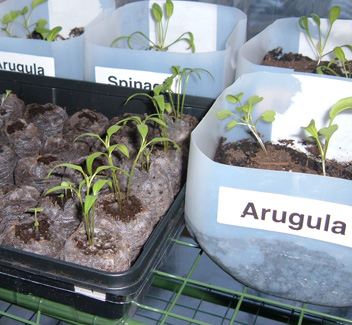
In terms of cost, we’re doing a few things differently this year. Luckily, we don’t need to purchase that large 27″ pot again, and it’s also early enough that we can start from seed, which is much cheaper. We picked up a few seed packets and a $5 Jiffy seed starter greenhouse that will grow 25 seedlings at a time. It was almost embarrassing to see that after two weeks of planting cucumber seeds, they were as big as the cucumber plants I bought last year for $4. Ugh. I also asked my coworkers for their empty gallon milk jugs and 2L bottles, which make great pots for smaller plants, such as herbs and salad greens. Our plan is to have tomatoes, cucumbers, jalapeños, and green beans outside, while growing herbs and salad greens (basil, oregano, arugula, spinach, lettuce, nasturtiums) inside. And if you’re leery of the cost of seeds (they do give you a lot), keep in mind that they are cheaper than buying a plant, and feel free to split the cost, and the seed packets, with other gardeners.
We also learned two important lessons last year. The first one is: add more compost later in the season! We started to see our plants slow down in growth and show signs of stress. You would think a huge pot full of soil couldn’t be depleted of nutrients, but it was. So keep some soil on hand to keep your plants happy. The second lesson we learned was that, on the 12th floor of a high rise building, bees don’t always know that you’re there. Our cucumber plant was flowering like crazy but we weren’t getting any cucumbers. In August, the bees showed up and started pollinating our cucumber plants. By then, we had done some research and figured out that cucumbers produce male and female flowers, so all you need to do is pull off a male flower, pull back the petals, and then rub it on a female flower. If we had known this, we would have had cucumbers growing in June.
So start your gardens now! Pick the fruits / vegetables you eat most and get those seeds started. By the time spring arrives, your seedlings should be large enough to plant outside. Don’t forget to water them, and your 2009 food bill should drop.
—–
When James isn’t tending to his garden, he is producing high-energy dance music that you can hear on iTunes or learn more at www.jamesroymusic.com.
Photo credit: James Roy.

James, thanks for the Spring gardening tips. I was going to cover this for Stretch Your Food Dollar, but you’ve done a great job of covering all the bases. Instead of spending the extra money to buy soil with compost, you could always make your own and really get more bang for your food buck.
http://www.queercents.com/2008/09/03/stretch-your-food-dollar-the-joys-of-gardening/
Thanks for the tip about the aphids! I’d started a couple herbs indoors (which is where the sun is, in my otherwise North-facing apartment), but always ended up with aphids, so annoying. I’m encouraged to try again. 🙂
Great guide, James. One small quibble — determinate plants are also easier to manage so some patio gardeners might find it worth the extra cost of buying an extra plant or two ($4 is still cheaper, most likely, than the buying the same amount of fresh produce) for the convenience of not having to deal with large vines. If you buy your second (or third) plant 3-4 weeks after the first one, it should keep your harvest going as one plant stops fruiting.
I’m have a yard with a small garden plot I got many veggies from last year- but this year I want MORE in the same space so I will container garden all of the herbs and peas (letting the peas crawl up the deck lattice)and leave more room for more tomatoes, beans and more!
Thanks so much for all the comments!
Serena – I’m a big fan of the Stretch Your Food Dollar series 🙂 Also have 2 more posts already written about indoor composting, so look for those in the near future!
Kristin – Glad to hear you’re ready to start some herbs again, especially since fresh herbs at the grocery store are rather pricey. Pulling the aphids off wasn’t the most glamorous of tasks, but they never came back. Granted our herbs were outside on the balcony, but I don’t think that made much difference.
Lyle – Great point, determinate plants are compact and you can stagger them over time. We found that the jalapenos we bought last year were nice and compact but showed a definite “due date” where they stopped producing. For such small plants [about 12″ tall], they produced a ridiculous number of peppers.
Moorea – I’m envious that you have a yard! Love the idea of maximizing your space, and you can even grow more herbs and lettuce greens indoors if you have the sun!
I’ve been finally crawling through the gardening catalogs this past week. Can’t wait to play in the dirt! 🙂